

In the industrial and Facility Management sectors, the race toward predictive maintenance and the integration of Artificial Intelligence has clearly begun. Yet despite the massive accumulation of data, uncertainty persists. The central question facing executives is no longer how to eliminate risk but how to convert it into strategic value through the convergence of Operational Technology and Information Technology. This perspective marks a profound shift toward what can be described as Maintenance 5.0. .
The word uncertainty originates from the Latin incertus, meaning not fixed or not assured. In ancient Rome it referred to what escaped human determination and evoked both fortune and destiny. During the Middle Ages, the term retained this dimension of chance but acquired a moral nuance. Uncertainty was then perceived as a sign of weak faith or incomplete knowledge. During the Renaissance the rise of scientific thinking began to transform its meaning by associating uncertainty with the measurement of error rather than with fatality. Astronomers and mathematicians such as Johannes Kepler and Galileo Galilei used uncertainty to describe the gap between observation and prediction. During the Enlightenment, the concept acquired a philosophical meaning. It referred to the human mind aware of its own limits yet capable of expanding its horizon through experience and reason. In the nineteenth century the notion evolved once again as it became embedded in the language of probability and statistics. Uncertainty became the domain of risk calculation and economic decision making. Today uncertainty has returned to the center of scientific, political, and industrial debates.
Uncertainty is no longer considered a flaw but a constitutive element of reality and in the context of Maintenance 5.0 it represents the manifestation of action and progress.
Uncertainty operates as an invisible asset circulating within organizations like a latent form of energy. Executives often attempt to eliminate it instinctively even though it is precisely what can generate lucidity. The most effective companies are not those that try to suppress uncertainty but those that learn to transform it into a resource. They convert it into information plasticity and invention. Beneath its apparently chaotic nature uncertainty acts as a collective cognitive capital stimulating vigilance renewing representations and forcing organizations to rethink routines and mental models. It compels actors to listen to resistance observe deviations and integrate weak signals before they evolve into crises.
Uncertainty converts disorder into active intelligence which is the only force capable of transforming an organization.
This form of intelligence should not be confused with doubt. Doubt is deeply human and belongs to individual consciousness. Uncertainty is systemic and flows through structures technologies interactions and dependencies. Traditional rationality attempted to predict systematically. The emerging paradigm seeks systemic adaptation instead. Classical management attempted to impose stability as the ultimate framework of action. The culture associated with Industry and Maintenance 5.0 now values transformation and continuous adaptation. Uncertainty is therefore no longer an accident of reality but a structural property of productive systems. The work of Philippe Silberzahn in Bienvenue en incertitude ! illustrates this perspective clearly. In complex systems, the attempt to predict leads to failure because it denies the nature of change itself. By contrast, adaptive approaches exploit variability and convert disorder into learning. This perspective converges with the analyses of Karl Weick and Chris Argyris. Intelligent organizations are not those that simply correct errors but those capable of questioning their own assumptions through experience. Uncertainty, therefore, becomes a powerful engine of double loop learning in which the questioning of established frameworks generates additional knowledge.
From the perspective of Maintenance 5.0 uncertainty becomes the foundation of operational intelligence.
Reports produced by the OCDE and the European Commission converge toward the same conclusion. The industrial structures of the future will need to be self sustaining and adaptive, capable of evolving alongside their environments. Complexity is no longer treated as a risk to be reduced but as an ecosystem to inhabit and invest. Within this perspective, uncertainty becomes a source of systemic innovation, stimulating exploration, feeding feedback loops, and enabling the emergence of unexpected solutions. The World Bank demonstrated this insight in the report Lifelines Infrastructure Opportunity. The most effective infrastructures are those designed to anticipate disruptions rather than avoid them at all costs. In the industrial domain, this means rethinking engineering and governance models. Predictive maintenance indeed relies on massive data collection, yet its effectiveness ultimately depends on the capacity of operators to interpret weak signals and tolerate uncertainty. The white paper Artificial Intelligence for Maintenance produced by CARL Software, emphasizes that artificial intelligence will not replace human judgment but expands the perceptual horizon of decision makers. The true value emerges from the interaction between algorithmic lucidity and human sensitivity, enabling organizations to exploit the variability inherent in technical systems.
Resilience, therefore, no longer means returning to equilibrium but creating new equilibrium from the elements that emerge during disruption.
Integrating unpredictability thus becomes a strategic issue. Organizations capable of engaging with uncertainty by modeling it without freezing it gain cognitive power. Herbert A. Simon famously emphasized that rationality is bounded. Thinking in complex environments, therefore, means arbitrating between multiple temporalities while continuously adjusting objectives. The most effective companies are those that accept this bounded rationality in order to explore new possibilities. Recent management research confirms this trend. Numerous studies identify strategic flexibility as the central competence of organizations operating within VUCA environments characterized by volatility, uncertainty, complexity, and ambiguity. A 2024 report from McKinsey & Company shows that competitiveness no longer depends primarily on accurate prediction but on the speed of collective learning. An agile, adaptable workforce becomes the principal strategic asset. Research conducted by Russell Reynolds Associates further reveals that four executives out of five identify uncertainty as their primary source of anxiety, while very few organizations possess effective collective learning mechanisms. This asymmetry between perception and preparation constitutes one of the major blind spots of contemporary management.
The strength of an organization no longer lies in its capacity to predict but in its ability to learn faster in order to expand its adaptive potential.
The automotive industry provides a clear illustration of this transformation. Supply chains destabilized during the pandemic forced manufacturers to reinvent production logic. Toyota Motor Corporation remained faithful to its principle of continuous improvement and transformed disruption into a knowledge accelerator by developing more autonomous and resilient manufacturing modules. By contrast, organizations that attempted to restore the previous order often became trapped in logistical dependency. Uncertainty thus functions as a strategic revealer, distinguishing those who endure crises from those who use them to reinvent themselves. This shift implies a new ecology of decision making. Edgar Morin anticipated this movement when he argued that complex thought is a mode of thinking capable of confronting and connecting uncertainty. Within organizations shaped by Industry and Maintenance 5.0 decision making is no longer the final step of analytical reasoning but rather a regulatory moment occurring at the intersection of data flows, human intuition, and field feedback. This approach already characterizes some of the most advanced technological ecosystems, particularly in aerospace and digital health, where the permanent revision of operational models has become a fundamental safety requirement.
Transforming uncertainty into strength now distinguishes those who passively undergo the world from those who reinvent themselves within it.
This paradigm shift introduces a new metric of performance centered on the speed of adjustment. The earlier an organization detects its own blind spots, the more effectively it converts uncertainty into advantage. This principle resonates strongly with the concept of antifragility developed by Nassim Nicholas Taleb. Certain systems do not merely resist shocks but benefit from them. This vision aligns closely with the philosophy underlying Maintenance 5.0 which seeks less to prevent failure than to understand and learn from it. From an economic perspective, uncertainty thus becomes a hidden strategic capital comparable to trust or reputation. It does not appear in accounting systems, yet it strongly determines an organization’s capacity for long term survival. In a global environment where stability is largely an illusion, this capital acquires unprecedented value. Organizations capable of cultivating it generate extended collective intelligence able to transform disorder into a productive resource. They invent a new way of inhabiting the productive world not by attempting to dominate it but by learning how to navigate within it. Uncertainty is no longer something to defeat. It becomes something to understand.
The true power of an organization is now measured by its capacity to transform blind spots into advantages.
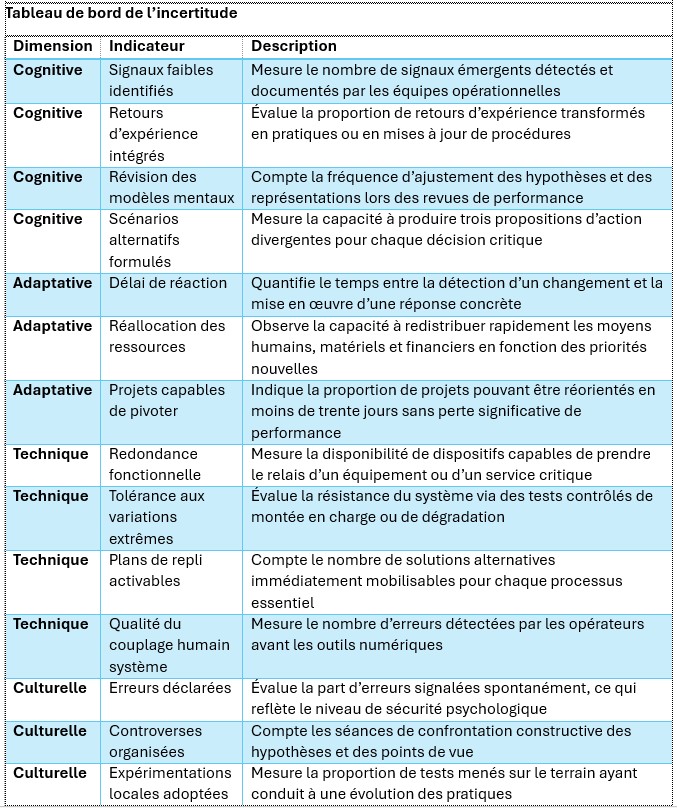
To conclude, it is useful to recall that several conceptual frameworks help structure the understanding of uncertainty even though a unified reference model does not yet exist. Two frameworks appear particularly relevant for analyzing unstable environments. The first is the BANI model, described as brittle, anxious, nonlinear, and incomprehensible, which extends the earlier VUCA framework and emphasizes discontinuity and the potential collapse of systems. The second framework, developed by the Organisation for Economic Co-operation and Development, analyzes how deep technological transformations reshape value chains and generate zones of structural uncertainty. Together these two reference frameworks provide a valuable foundation for constructing an uncertainty dashboard capable of illuminating both the psychological and systemic dynamics that traverse organizations. Their combination makes it possible to imagine a multidimensional metric able not only to measure exposure to uncertainty but also to evaluate an organization’s competence in transforming uncertainty into a strategic resource.
Mustapha Derras