

Failure is no longer a malfunction but a strategic revealer of operational truth. It unveils what performance conceals and what control overlooks. Each rupture opens a raw passage to reality and reshapes the way action is conceived. What follows is an exposition of a shift toward an industrial intelligence that learns from disorder.
At the core of failure lies an issue rarely understood. What is revealed is not merely the weakness of a technical system but the exposure of the true nature of its functioning in all its density and unpredictability. Failure is an event that “tears continuity” and grants access to a technical world that stops obeying. In this breach an unexpected encounter occurs with the real, face-to-face that suspends automatism and forces a reconsideration of the relationship between knowledge and action. Each disruption, each moment of machine silence, and each deviation in a flow or signal becomes an unknown language the organization must decode. Failure interrupts, disorients, and displaces, yet this displacement is fruitful because it breaks certainty to make room for understanding. What truly breaks in failure is not only a mechanism but also a worldview. The organization discovers in this operational snag the limit of its automatisms and the fragility of its cognitive routines.
Failure reveals what indicators ignore and transforms each unforeseen event into a strategic resource to improve the organization’s performance over time.
Maintenance 5.0 turns this rupture into a field for capturing knowledge. It no longer attempts to ward off uncertainty but to extract meaning from it. The failure event becomes a thought experiment and a source of learning. Chris Argyris extended by the analyses of Kevin M. Clark and by the foundational work of John Dewey and Kurt Lewin on reflective thinking, has demonstrated that the most resilient organizations are those that question their interpretative frameworks as much as their practices when facing setbacks. In this perspective, failure is not an accident but a “double-loop” learning opportunity. It invites an inquiry into how action is performed and how action is conceptualized. It opens a reflective space in which technology, humans, and the organization renegotiate their interactions. In the tension provoked by rupture, a collective’s capacity to make sense is reinvented. Karl Weick named this process sensemaking, the craft of rebuilding meaning at the heart of the unexpected.
Accelerating knowledge capture by turning each rupture into an immediate driver of organizational progress.
In this “economy of failure,” knowledge no longer precedes action but emerges from it. Amy Edmondson has shown how psychological safety underpins the possibility of collective learning. Failure becomes a learning source only if it can be narrated without fear. The organization must therefore create the conditions for sharing experience in which vulnerability becomes a lever of effectiveness. Failure becomes a moment of regained humanity in an environment saturated with automatism. It restores dialogue between technical intelligence, field intuition, and listening to reality. Each incident documented, replayed, and collectively interpreted feeds a living memory. What matters is no longer the return to normal but the transformation of normality itself.
Philippe Silberzahn, drawing on effectuation theory and the critique of prediction, reminds us that uncertainty is not a deficiency of the system but the raw material of action. Failure is its concrete manifestation and eruption of the unforeseen that forces adjustment, creativity, and reinvention. Nassim Nicholas Taleb has shown that systems learning from shocks become antifragile because they strengthen through their errors. Such organizations do not shield themselves from disorder; they feed on it. Each failure becomes micro training in resilience. Yossi Sheffi’s work reinforces this view by showing that the capacity to absorb disruption depends on organizational plasticity. What matters is not avoiding rupture but converting it into a resource that ensures continuity. Measuring repair time is no longer sufficient because one must also measure the quality of knowledge generated by disruption.
Strengthen the organization by transforming vulnerability into immediate operational advantage.
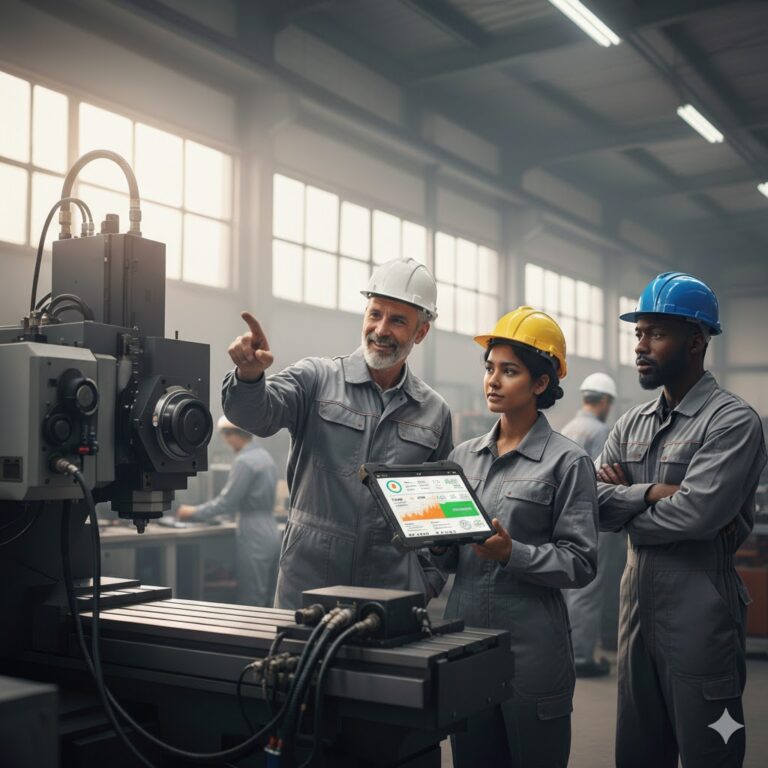
Learning through failure requires a redesign of organizational grammar. It rests on accepting that knowledge is situated, woven through action and through the dialogue between lived experience and data. Far from dashboards, it plays out in narrative and in the confrontation of interpretations. Organizations that grasp their value establish processes that allow failures to be replayed, analyzing visible causes and invisible logics. Sensors, algorithms, and operators are no longer separate entities but media within the same sensitive system. From these exchanges emerges an ecology of memory that current technologies can capture with fidelity. The most detailed descriptions of past incidents become seeds for future decisions. Failure takes the role of a silent teacher with a compelling reflection on what usually remains unnoticed or unspoken. Through failure, Maintenance 5.0 reshapes the relationship to time and technology. It breaks from the logic of control inherited from Industry 4.0 and adopts a logic of listening, discernment, and co evolution. Where performance sought stability, predictability, and mastery, failure reintroduces plasticity, adaptability, and vigilance. In this sense, learning from failure is the industrial equivalent of what cognitive science calls metacognition the ability of a system to reflect on its own learning. It transforms incidents into reflective moments and turns the human machine collective into a knowledge organ. Numerous emblematic failures illustrate this.
Each incident becomes a living decision-making asset that evolves the organization faster than its routines ever could.
In a European power plant, a failure in the backup power system revealed that both the primary and backup systems shared the same vulnerability to flooding. The post incident analysis led to a complete overhaul of emergency scenarios and to systematic testing of simultaneous failures. Engineers realized that backup systems were not merely technical duplicates but actors within a reflexive ecosystem in which each failure must be treated as a knowledge event. This insight, documented in a Joint Research Centre report, illustrates how failure becomes a vector of collective discernment.
Another example comes from industry, where an unexpected failure during a planned shutdown forced a total reorganization of planning. Maintenance and production leaders set up a workshop, gathering technicians’ subcontractors, and engineers to analyze the event. The exchange identified not only mechanical causes but also communication errors and organizational inertia. This experience reported by Broadleaf Capital International fostered a culture of narrating incidents as tools for shared intelligence.
Finally, the major North American blackout of 2003 documented in the report of the North American Electric Reliability Corporation remains a reference in systemic failure analysis. It revealed how a succession of ignored weak signals combined with maintenance gaps and obsolete software indicators could trigger the collapse of an interconnected grid. The conclusions of this crisis led to a deep overhaul of supervision and coordination standards. Data ceased to be traces of a digitized fiction and became the material for collective learning about reality on a continental scale.
Contingency creates the foundation for a sustainable methodological reinvention because the ignored weak signal already contains the major catastrophe.
Under this lens, failure becomes the beating heart of an expanded organizational intelligence augmented by modern data capture capabilities. In the framework of Maintenance 5.0, human-machine teaming combined with advanced artificial intelligence and instrumentation systems creates a learning environment. Digital twins reproduce asset behavior in real time, offering the ability to simulate failures, observe their effects, and derive insights without stopping production. Collaborative feedback platforms aggregate operator and machine signals to feed shared knowledge bases. Cognitive AI analyzes anomalies, detects weak signals, and assists technicians in interpreting root causes. This techno-human ecosystem transforms data into knowledge and establishes true collective reflexivity in which every failure becomes an opportunity for systemic learning and continuous improvement. It reminds us that reality is never fully domesticated and that technology remains an interlocutor, sometimes recalcitrant, often instructive.
By accepting this resistance, the organization reconnects with a phenomenology of action. A major principle thus returns to the forefront: accepting that to know is to allow oneself to be instructed by what escapes control. Learning from failure turns disorder into a teacher and surprise into a valuable raw material. It lays the foundation for a new generation of maintenance that thinks a productive apparatus capable of understanding itself in action and an industry that transforms the unforeseen into the driver of its lucidity and evolution.
Save - Mise en forme T1